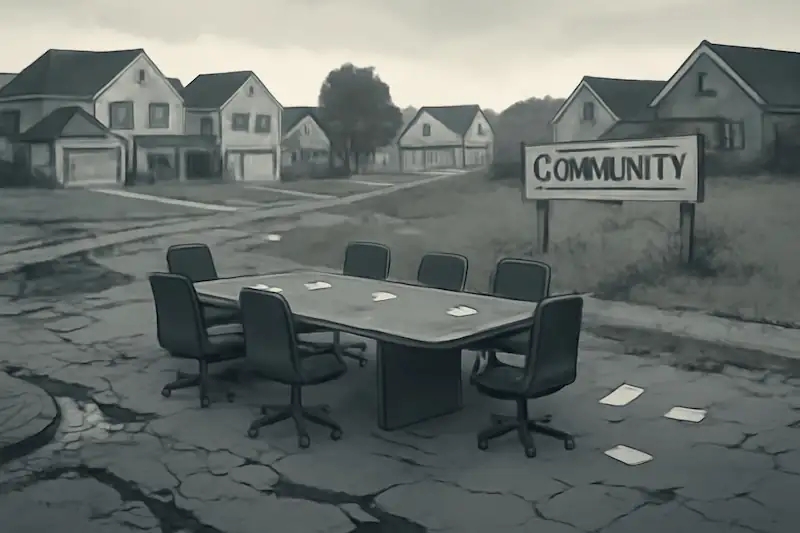
Buying into a homeowners association means entering a business partnership with strangers. When a board stops acting like a responsible corporation and begins operating as a private club, the structural foundation of the community collapses. The following examples represent objective governance failures documented in cases where statutory abandonment replaced fiduciary duty.
Unrecorded and Expired Governing Documents
A primary indicator of failed governance is the use of unrecorded or expired governing documents. Boards sometimes distribute updated restrictions to new buyers to encourage investment, only for owners to discover years later that those documents were never recorded at the county level and carry no legal weight. This creates corporate limbo where some owners follow rules from the 1980s while others rely on 2017 versions that exist only in email attachments. The lack of a clear legal floor makes property sales and mortgage approvals nearly impossible.
Infrastructure Management as Hobby
Infrastructure management often becomes a hobby rather than a professional obligation. A common failure occurs when boards reject professional engineering reports in favor of hiring unlicensed individuals with tractors. In one scenario, a board ignored an $8,000 engineered drainage fix to keep dues palatable, which directly contributed to a multi-million dollar road collapse during a storm. Prioritizing short-term cost savings over professional standards guarantees long-term destruction of communal assets.
Statutory Negligence in Financial and Administrative Duties
Statutory negligence extends to financial and administrative duties. Documented cases include associations failing to file corporate tax returns for nearly two decades or allowing liability insurance to lapse for years without notifying owners. When a board admits on the record that they are unqualified to hire contractors or manage road construction yet refuses to hire a professional property management firm, they choose personal control over risk reduction.
Transparency Replaced by Appearance of Function
Boards may pay for management software to generate polished reports yet use that same software to hold secret meetings, count their own ballots in anonymous elections, or disenfranchise dissenting owners without the due process required by state law. True clarity requires that records like bank statements, meeting minutes, and professional bids be reasonably available to all owners.
The Case for Court-Ordered Receivership
When a board admits it is in over its head but remains attached to its power, the community enters a state of ongoing harm. The logical solution to this level of mismanagement is the appointment of a court-ordered receiver. A receiver removes the personalities from the process and restores the association to a functioning legal entity. If your board views law as a suggestion and professional expertise as an unnecessary expense, your investment is at risk.